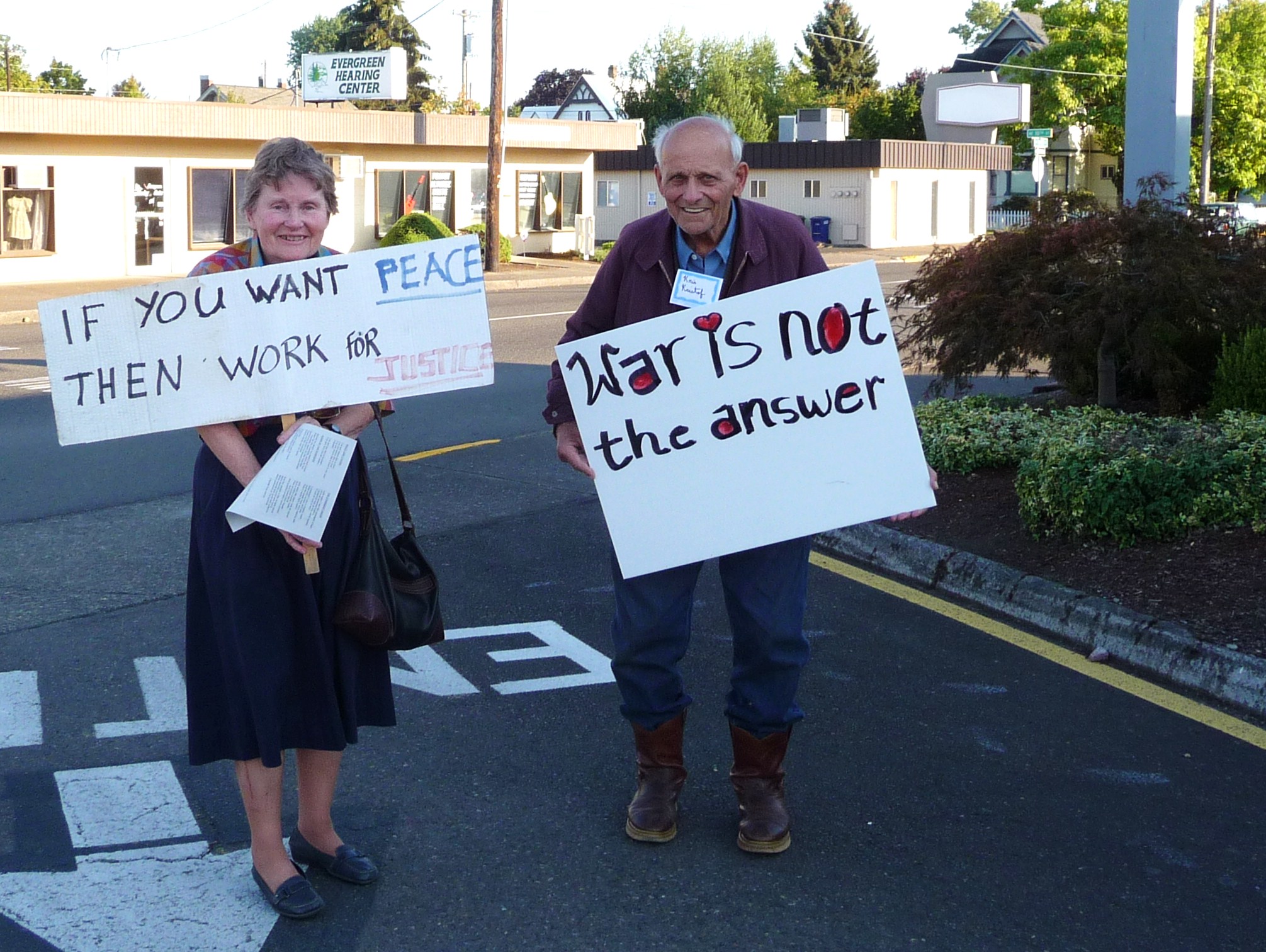
Remembering Ladis Kristof

Group 48 is mourning the death of one of our founders, Ladis “Kris” Kristof who passed away earlier this week. Kris was actively involved with Group 48 until his death. A brief account of his life is featured in the Oregonian. He will be sorely missed. Funeral service is scheduled for June 23rd, 11am at St John’s Catholic Church (445 North Maple Street, Yamhill, OR 97148).

Please share your memory of Kris in the comments.

If you have photos of Kris you can share with Group 48, please use the Contact page to notify us.


Update – June 19, 2010: Kris’ son, Nicholas Kristof published thoughts on his father in his column and blog at The New York Times:

Jane & Ladis Kristof

Comments

12 responses to “Remembering Ladis Kristof”

  1. Marylou Noble

    I will always remember Kris as a person with a ready smile and a great sense of humor who made significant contributions to Chapter 48 meetings. I have an especially fond memory of dining with Kris and Jane following Nicholas’ presentation at a conference in Eugene.

  2. Mary Loos

    One time I got an email from Jane inviting (me) to lunch at a restuarant near PSU and he paid for it. It was a nice time, but I don’t now know what we discussed! My thoughts are with hsi family. Mary Loos

  3. Will Ware

    A great scion of our tribe has passed and I am lighting every candle within my reach to illuminate his passage. My heart goes out to Jane and her family. Such a lovely man. So sad. But celebrate his very special and meaningful life. I treasure the many moments he was with us in heart and spirit where he will remain evermore in our work.

  4. marcus thomas

    I remember the last time I spoke to Ladis. He was wearing a cast on his foot, and I asked him what had happened to his foot?
    Ladis smiled and replied, ” I have been walking on it for ninety years.”
    I remember Ladis telling me about this love of farming. How he chose Portland State because it allowed to own a farm at the same time that he taught at the University…How important the land and farming were to him.
    I remember being told how Ladis once went to Dulles Airport in Washington D.C. with a large photograph of a prisoner of conscience. How he stood in the lobby of the airport to attract attention of government officials and other important people who routinely pass through Dulles airport.
    I wish I could remember more.
    Betty and I feel it was a great privilege to have known Ladis.
    marc thomas

  5. erika swiberg

    I did not know Ladis Kristof well, as I have been a member of Group 48 less than a year, but it was always a pleasure to see him at the meetings; he seemed like a kind soul. My heart goes out to Jane and their families.

    -Erika.

  6. Ramzi Twal

    Mr. Kristof was one of my professors at the University of Waterloo, Ontario before leaving to Portland. I am sorry to hear of his death. Great man, great professor. His encouragement prompted me to start a little monthly publication for about 2 years.

  7. Daniel Johnson

    Ladis was always an inspiration to me ever since I arrived in Portland. He was always interested in legislative and policy action, and that really caught my attention. To see someone who had been a part of the group for so long still focused and excited about policy work really solidified my beliefs that it was effective and worthwhile work to pursue. It was amazing to read about his history, and to think of his words in that light. I still think of him from time to time, and am honored to have had a chance to meet him.

  8. Krystyna Wieczffinska

    A short note after the death of my last cousin Sławek ( Wladysław Krzysztofowicz vel LADIS KRISTOF), deceased on June 16th 2010 at Yamhill

    Krystyna Wieczffińska-Janicka; Kraków, Poland, Europe, July 2010

    Armenia, situated in the Caucasus region of Eurasia, was in the 1st and 2nd century part of Persia and the Eastern Roman Empire.
    After getting independence in the 3rd and 4th century the country adopted Christianity of the Georgian Rite, its head being the Patriarch.
    Incessant invasions in the 13th and 14th century weakened the country. Around 1550 Persia and Ottoman Turkey divided Armenia between themselves.
    The partition of the Armenian Kingdom brought mass relocations and extermination of its population.
    It was then, most probably, and in the following centuries, that a larger number of Armenians settled at the eastern territories of the Kingdom of Poland and the Grand Duchy of Lithuania.
    From Iassy, through Suceava up to Zhitomir at the north and Lvov at the west, they were granted rights and privileges by king Casimir the Great, and later his successors, who acknowledged their religious, administrative and judicial autonomy.
    The Armenians brought to Poland their art, culture and tradition. They were tradesmen, breeders and farmers. Very quickly they adopted the Polish language and custom.
    At that time they formed a union with Rome, constituting the Armenian Catholic Church in Poland with the seat in Lvov, and Polonized their names, adding the ending “wicz”.
    Before World War I (1914-1920), and afterwards, the former eastern borderlands of Poland, were inhabited by numerous, friendly coexisting nations: the Poles, Armenians, Jews, Caraites, Tartars and Ruthenians, (called nowadays the Ukrainians). They constituted a unique, multi-cultural world – totally destroyed as a result of political and social intrigues of the occupants in later years.

    Władysław Krzysztofowicz – (called by the family Sławek, vel Ladis K.D.Kristof) was son of Maria nee Zawadzka (Polish) and Witold Krzysztofowicz (Armenian). He was named Władysław after his mother’s brother, who fell at the Italian front during World War I.
    He was born on November 24th 1918 in Cernauti at Bukovina, where his parents owned a large estate.
    The Duchy of Bukovina, situated at the borderline of Polish, Russian and Romanian lands, was at that time part of the Austro-Hungarian Empire.
    Władysław, with his elder siblings, was brought up on the family estate in Karapczyjów on the river Ceremus, in the home where Armenian traditions were closely bound with Polish customs. His family spoke Polish at home, but the children had a German nanny – “Fraulein Dadi” so their knowledge of German was perfect. Then a teacher from France appeared, thus French became the third language Sławek mastered in his childhood. The villagers spoke Ruthenian.
    The year 1918, the birth year of Sławek, brought the collapse of the Austro-Hungarian Empire. Bukovina became incorporated into Romania and Poland.
    The estate of the Krzysztofowicz family found itself inside the new Kingdom of Romania.
    Władysław (Sławek), with his siblings, received his primary education at home, and later he attended secondary school in Lvov and Buczacz, in Poland, living with my parents – his aunt and uncle.
    In 1939 he began his studies at the department of forestry at the University of Poznań (Poland), but the German aggression on Poland (on September 1st) caused the outbreak of World War II and put an end to his plans.
    In this war Romania became the ally of Germany (from economic rather than ideological reasons), forming a block of fascist countries, together with Italy, Hungary and Japan.
    As Romanian citizen, Władysław was enlisted into the Romanian army. Fortunately, he was assigned to quartermaster and supply services, so he never had to fight on the front.
    His father, Witold, his sister Maria (Litka) and brother Janusz served in the Polish Underground Army AK.
    As result of treason his brother and sister (and father, though for a short time) were arrested by the Romanians and sent to a fascist Romanian camp, but all of them survived the war and the Romanian and German camps, and they managed to avoid Russian deportations to Syberia.
    In 1946, and later, like many fugitives from the eastern borderlines of Poland, the whole family repatriated to Cracow, (Poland), where the parents, Maria and Witold, died after several decades and were buried at the Rakowice cemetery in the Krzysztofowiczs’ family grave.

    In 1943 the soviet army entered Romania, bringing communism and nationalisation of private property. The Krzysztofowicz estate in Karapczyjów, partially burned, was transformed into an agricultural sovkhoz, owned by the communist soviet republic.
    To avoid arrest, as a former Romanian soldier, Sławek (Ladis) fled to Yougoslavia, swimming across the Danube River, but he was quickly caught and sent first to prison and then to a concentration camp.
    As prisoner, he worked in an asbestos mine, and then in a logging camp – starving under inhumane conditions. Thanks to the kindness of local people and his language skills he managed to escape via the sea and Italy to France, to Paris (around 1950), where he was supported by Felix Zawadzki, his mother’s brother, who stayed in France after being released from a POW camp.
    In France Sławek (Ladis) found a job in hotels and private houses, often as cleaner, but soon he met an American family – the Camerons, who offered him help and sponsorship for immigration to the US. He arrived in Portland in 1952, and took a logging job to earn money for his future university studies.
    After getting a degree in political science, in Portland, he continued his studies and research at other renowned American universities. In 1971 he accepted a teaching position at Portland State University, and he worked there until his death.
    Widely recognised for his academic achievements, he lectured at various universities all over the world, also in Poland and Romania. Always eager to help those in need, he supported a school in the Ukraine, in his hometown Karapczyjów, and the publications of the Association of Buczacz Inhabitants in Wrocław (Poland).
    He visited his family in Poland and France, keeping in touch with his brother Janusz (in Poland), and sister Litka (in Canada), and my mother – his aunt) Dyoniza Wieczffińska – as well as with the distant relatives: the Krzysztofowicz and Zawadzki families.
    He built his new life in the US having in mind the image of his distant, lost home in Karapczyjów. He built a farm in Yamhill, where he planted a forest, raised livestock and wild animals, and hunted. But, above all, he lived a rich intellectual life and helped those in need – just like in his youthful years.
    Sławek, you will always live in our memory!

    1. Niall Macnaughton

      Than you for writing this history. Fortunately knew all members of the Krzysztofowicz family where they visited dearest friend Litka in Waterloo, Ontario. Litka became an exceptionally important part of my own family life for 40 years. Knew Kiki (Nicholas) as a frequent visitor to his Aunt Litka’s various moble-home farm-based homes. He has deservedly become world famous for his many wonderful writings and causes. I last met him- his age 13 my age 21 – with his fabulous Dad and Mom in Waterloo. He has grown to look exactly the
      male version of his amazing Aunt who enthralled me and myriad others with sometimes endearing, at times horrific tales, of the famille K’s history.
      Niall Macnaughton- Victoria, BC

      1. Will Ware

        A lovely man and an amazing family. He is remembered. Never give up and have patience. The evolution of human consciousness is an eternal process.

  9. Amjad Jaimoukha

    I have never met the distinguished man and scholar, but his review of my book “The Circassians” in “Choice” magazine literally changed my life. The Polish people have always had a soft spot for the struggle of the Circassians against occupation and oppression. The Circassians in their turn still keep fond memories of the heroic Poles that helped them in their dark days. Prof. Ladis Kristof had kept up the honourable traditions of his great nation. I would gladly have his kind words for my epitaph.

  10. Dr. Wayne A. Schroeder

    I was a graduate student of Dr. Kristof while obtaining and M.A. in Political Science at Portland State University. He was a compassionate man who was truly dedicated to peace. In a world torn by war and conflict, we all should seek to emulate these qualities and pass them on as best we can.

Leave a comment